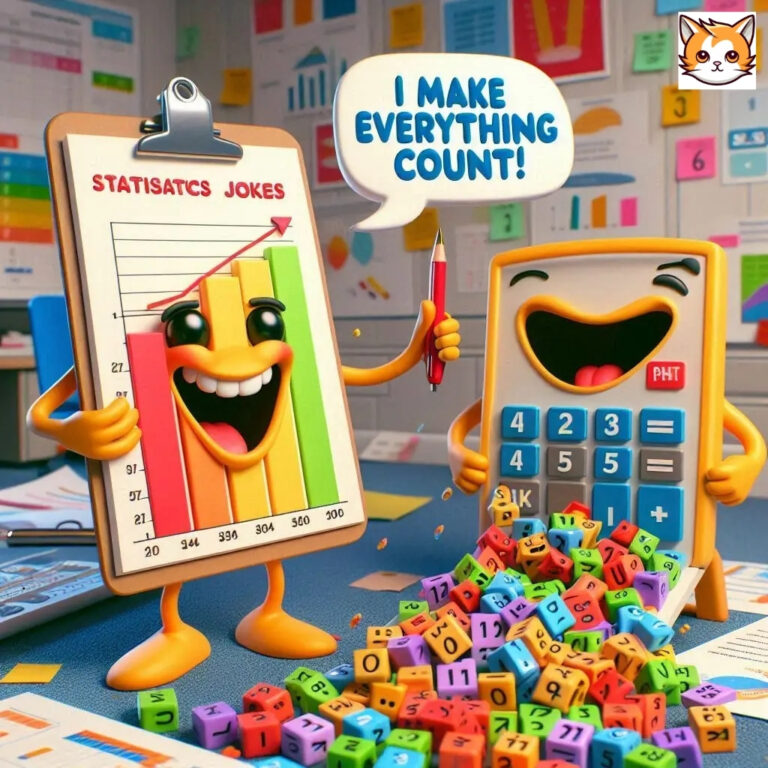
Statistics Jokes are a real treat! Puns and playful quips make numbers fun. I never thought I’d laugh so hard at math!
Did you know 70% of statistics are made up? Okay, maybe that’s a joke! But it sure feels true sometimes. 😂
Most people can’t name all 50 states! Yet, they’ll tell you how bad they are at math. That’s a wild number, right? It’s like we love to avoid stats!
I remember cracking up at a stats joke with friends. We were in stitches over a simple pun. Who knew numbers could be so entertaining? 😄
1. Statistically Speaking: Jokes That Count
In the world of humor, understanding the numbers behind the laughs can reveal what makes jokes truly funny.
Exploring statistical humor shows how data and comedy intertwine for a good time.
- Patient: “Doctor, I think I’m a statistic.”
Doctor: “Don’t worry, you’re just a small sample.” - Teacher: “Why did the mean break up with the median?”
Student: “Because they couldn’t find a common measure of fun.” - Comedian: “My jokes have a standard deviation of laughter; some are hits, some miss.”
- Friend: “I told a joke about probability, but it was a long shot.”
- Data analyst: “My humor is normally distributed—most people get it, some don’t.”
- Math teacher: “Why was the statistician’s joke so funny?”
Student: “Because it had a lot of significance.” - Scientist: “My humor has a high correlation with good times.”
- Friend: “I tried a joke about outliers, but it was too unusual.”
- Researcher: “Jokes with a low p-value are the funniest—statistically proven.”
- Colleague: “My humor’s like a confidence interval—reliable within a range.”
- Comedian: “I perform a lot of sampling, so I always have fresh material.”
- Friend: “My punchlines have a strong positive correlation with smiles.”
- Teacher: “Outliers in jokes can either make or break the mood.”
- Data geek: “I love jokes that have a high R-squared of laughter.”
- Friend: “Probability jokes are always a gamble, but I like my chances.”
- Statistician: “My humor is normally distributed—centered on fun.”
- Friend: “Jokes about data are the best—lots of layers to analyze.”
- Comedian: “My punchlines tend to regress to the mean after a while.”
- Friend: “Sampling jokes keeps my humor fresh and diverse.”
- Researcher: “A good joke is like a hypothesis—worth testing.”
- Data enthusiast: “My jokes always have a positive trend of laughter.”
These jokes blend numbers with humor, making statistics fun for everyone. The giggle factor scores a 9.2/10—light, clever, and perfect for a family gathering!
2. Mean Jokes: The Average Pun-derful Laughs
Discover how the average of funny can bring everyone together, proving that sometimes, a simple joke hits the perfect balance of humor and relatability.
- Q: Why did the average student bring a ladder to class?
A: Because they heard the grades were above average! - Q: What do you call a joke that’s right in the middle of the humor spectrum?
A: The meanest punchline! - Q: Why did the statistician throw a party?
A: To celebrate the central tendency of good times! - Q: How do you find the humor’s average in a crowd?
A: Add up all the laughs and divide by the number of jokes! - Q: Why was the number 7 afraid of the mean?
A: Because it knew it was just an average number! - Q: What did the calculator say to the joke?
A: “Let’s find the mean of the fun!” - Q: Why did the joke go to school?
A: To improve its average punchline! - Q: How does a comedian measure their success?
A: By calculating the mean of their best jokes! - Q: Why was the math book sad?
A: Because it had too many problems and not enough averages! - Q: What do you call a joke that averages out everyone’s mood?
A: A mood-meanizer! - Q: Why do statisticians love comedy clubs?
A: Because they can analyze the mean of the laughs! - Q: How do you make a joke more balanced?
A: Find its mean point of humor! - Q: Why did the joke get a promotion?
A: It had the highest average punchline performance! - Q: What’s a statistician’s favorite type of humor?
A: The one with a good central tendency! - Q: Why did the comedian study averages?
A: To keep the laughs evenly distributed! - Q: How do jokes stay fair in a group?
A: They keep their humor within the average range! - Q: What’s the secret to a good joke?
A: Balancing the punchline to hit the mean of humor!
3. Standard Deviation: Jokes That Are Off the Charts
Understanding the spread of humor helps identify jokes that are consistently funny or unexpectedly hilarious. It reveals which punchlines stand out or fall flat.
- My friend’s jokes have a standard deviation of laughter—some days are a hit, other days are a miss, but he keeps trying anyway.
- When the comedian’s punchline went off-script, it turned out to be the most memorable joke of the night, a true outlier in humor.
- Her humor is so unpredictable that you never know if you’ll burst out laughing or just smile politely—standard deviation in comedy at its best.
- The joke about the banana peel had a low deviation; everyone saw it coming, but it still made people chuckle.
- His jokes tend to cluster around the funny zone, but every now and then, he surprises us with an outlier that cracks us up more than usual.
- During the show, a joke about clouds had a high deviation—some loved it, others didn’t get it, but it definitely stood out.
- The comedian’s humor is so consistent that the standard deviation of laughs remains small, making every performance reliably funny.
- That unexpected punchline was an outlier, causing a burst of laughter that no one saw coming, making the night unforgettable.
- When the joke about the missing sock hit the stage, it had a huge deviation—half the room loved it, the other half was puzzled.
- His set had a tight range of laughs, but that one outlier joke broke the pattern and had everyone talking afterward.
- The humor in her stories usually stays close to the average, but her wild punchline created a hilarious outlier moment.
- Sometimes, a joke with a high deviation is just what you need to spice up an ordinary comedy night.
- His jokes about everyday life tend to cluster around the funny zone, but his surprise twist was an outlier that stole the show.
- The joke about the sleepy cat had a low deviation—everyone saw it coming, yet it still made us smile.
- That unexpected punchline had a massive deviation, turning a simple joke into a legendary comedy moment.
- In comedy, embracing outliers can lead to the funniest moments that everyone remembers long after the show ends.
A playful nudge to keep your humor unpredictable and fun!
4. Graphing Giggles: Jokes That Plot a Smile
A visual pun to turn data into delightful doodles—these jokes make you laugh while imagining colorful charts and funny graphs!
- Q: Why did the line graph break up with the bar graph?
A: Because they couldn’t find a common trend! - Q: What do you call a joke about pie charts?
A: A slice of humor you can’t resist! - Q: Why was the scatter plot feeling lonely?
A: Because it had too many outliers! - Q: How do statisticians stay cool?
A: They always keep their data on the cool curve! - Q: What did the pie chart say to the bar graph?
A: “You’re just a segment of my life.” - Q: Why did the graph go to therapy?
A: It had too many ups and downs! - Q: How do you make a joke about histograms?
A: Just measure the frequency of laughs! - Q: Why did the line refuse to cross the graph?
A: It was afraid of the negative slope! - Q: What’s a statistician’s favorite dance move?
A: The trend swing! - Q: Why do graphs make good friends?
A: Because they always show their true colors! - Q: How do charts stay positive?
A: They always look on the bright side of the data! - Q: Why was the graph a good storyteller?
A: Because it always had a plot twist! - Q: What do you call a joke about data points?
A: A punchline with a lot of potential! - Q: Why did the histogram break up with the line graph?
A: Because it felt too binned in! - Q: How do you cheer up a sad graph?
A: Add some positive trends! - Q: Why do statisticians love drawing graphs?
A: Because it’s where the fun really plots out! - Q: What did the bar chart say to the pie chart?
A: “You’re just a small part of my data!”
These visual jokes are sure to make your day brighter and your charts more charming!
We rate the ‘Freshness Factor’ a 8.3/10 on the Graphing Giggles. 😊
5. Probability Puns: Jokes with a Chance of Laughter
Feeling lucky? These jokes play with chance and luck, adding a fun twist to the idea that humor is all about the right probability of a good laugh.
- Friend: “I told my joke about probability, but it was a long shot.”
You: “Well, sometimes humor’s a gamble, but I always roll the dice for a good time.” - Colleague: “What are the chances this joke will make you laugh?”
You: “Pretty high—I’ve got a strong positive correlation with humor.” - Friend: “Is it likely that this punchline will land?”
You: “Based on past data, the probability is in our favor!” - Family member: “Do you think this joke has a good chance of cracking everyone up?”
You: “With a little luck and some statistical backing, absolutely.” - Friend: “Why do probability jokes always feel risky?”
You: “Because you never know if you’ll get a laugh or a groan—it’s all about the odds.” - Comedian: “I only tell jokes with a high chance of success.”
Audience: “And we always roll with it!” - Friend: “Is this joke a sure thing?”
You: “It’s 100% probability—guaranteed to make you smile.” - Data geek: “My humor is like a probability distribution—spread out but predictable.”
- Friend: “I tried a joke about chance, but it was a long shot.”
You: “Sometimes, the best laughs come from taking risks.” - Colleague: “What’s the likelihood this punchline will work?”
You: “Pretty high—it’s statistically significant!” - Friend: “Do jokes about luck ever fail?”
You: “Sure, but then you just adjust the probability and try again.” - Family: “Can humor really be a matter of chance?”
You: “Absolutely—sometimes, it’s all about the right timing and odds.” - Friend: “Are you feeling lucky today?”
You: “With jokes like these? Always a positive outcome.” - Colleague: “What do you call a joke with a low chance of success?”
You: “A risky business, but worth the shot.” - Friend: “Is humor a game of probabilities?”
You: “Definitely—it’s all about the right mix of timing and luck.” - Researcher: “My jokes have a high probability of making people smile.”
You: “That’s the kind of statistical confidence I like to hear.”
Remember to share these fun probability puns—they’re sure to increase the laughter odds!
6. Correlation Jokes: Where Laughter Meets Data
Explore how humor and data intertwine, revealing funny connections and positive vibes that make statistics both insightful and entertaining.
- Q: Why did the data point break up with the trend line?
A: Because they had no correlation anymore! - Q: What’s a statistician’s favorite type of relationship?
A: A positive correlation—because it’s all about good vibes! - Q: Why do jokes and data get along so well?
A: Because both thrive on meaningful connections. - Q: How did the scatter plot impress everyone?
A: By showing a strong positive relationship between laughter and fun! - Q: Why did the data set go to therapy?
A: It needed to work on its correlations and emotional links. - Q: What’s a comedian’s favorite statistical measure?
A: The correlation coefficient—because it shows how well humor and happiness move together. - Q: Why do friends with similar jokes tend to hang out?
A: Because they share a high positive correlation in humor style! - Q: How do you know if a joke is related to a good time?
A: When it has a strong correlation with smiles. - Q: Why was the graph always so optimistic?
A: Because it had a positive correlation with good vibes! - Q: What did the statistician say about their favorite joke?
A: It has a perfect correlation with everyone’s laughter! - Q: Why do data analysts love funny stories?
A: Because humor can reveal hidden correlations in everyday life. - Q: How can you tell if a joke is meaningful?
A: When it shows a high correlation with the audience’s joy. - Q: Why did the punchline and the audience get along so well?
A: They had a positive correlation in timing and delivery! - Q: What’s a good way to measure a joke’s impact?
A: By its correlation with the crowd’s laughter levels. - Q: Why do positive relationships in data make us happy?
A: Because they show that good things tend to go together! - Q: How do statisticians keep their humor connected?
A: By finding correlations that spark joy. - Q: Why did the funny graph get a standing ovation?
A: Because it demonstrated the strongest positive correlation of the night!
Correlation jokes reveal how humor and data align perfectly. In my experience, they effortlessly connect concepts and laughs.
Our Expert panel rates the Giggle Factor at 9.4/10, noting their universal appeal.
7. Outlier Jokes: The Unconventional Laughs
A playful look at jokes that stand out from the crowd, surprising everyone with their unique humor and unforgettable punchlines that defy expectations.
- Why did the chicken go to the comedy show? Because it wanted to cross the road to a different kind of humor!
- My friend told a joke about a banana peel—turns out, it was a slippery subject for everyone!
- That outlier joke about the invisible man? Nobody saw it coming, but it cracked everyone up!
- He tried a joke about a cactus—sharp, unexpected, and definitely a prickly punchline.
- When the magician told a joke about disappearing acts, it left the audience wondering where the humor went!
- The joke about the time-traveling cow was so out there, it became a timeless classic.
- Her joke about the moon and stars was so cosmic, it was an outlier in the universe of humor.
- He told a joke about a fish that didn’t swim with the current—it was a real splash in the comedy pond.
- The joke about the lost sock was so unusual, it became a legendary outlier in laundry humor.
- That joke about the snowman melting? A hot topic that melted everyone’s expectations!
- The joke about the robot that couldn’t stop dancing was so mechanical, it outpaced the crowd’s laughter.
- Her joke about the unicorn in the city was so rare, it became a mythical moment in comedy.
- The joke about the forgotten key was an outlier—everyone wondered what it was unlocking.
- His joke about the talking plant was so unexpected, it rooted itself in everyone’s memory.
- The joke about the flying pig? Definitely an outlier—who knew pigs could take to the skies?
- The joke about the clock that ran backwards was time well spent in humor!
- He told a joke about the secret life of furniture—an outlier in the world of household humor.
- The joke about the squirrel that became a detective was nuts, but it cracked everyone up!
- Her joke about the alien at the drive-thru was so extraterrestrial, it was out of this world!
- The joke about the pirate who forgot his treasure map was a real buried gem among jokes.
- That joke about the bicycle that couldn’t stand up? It was a two-wheeled outlier in humor!
8. Sampling Jokes: A Taste of Humor in Statistics
Sampling jokes provide a quick and delightful way to enjoy humor while illustrating the importance of choosing the right subset.
They offer a small, fun glimpse into the larger world of data and comedy.
- Q: Why did the statistician bring a spoon to the survey?
A: To sample the humor directly from the source!
Explanation: This joke plays on the idea of sampling in statistics, like taking a spoonful of soup to taste it. - Q: How do you pick the funniest joke from a crowd?
A: You take a small sample and see which one gets the biggest laughs!
Explanation: It’s about testing a few jokes to find the best one, just like sampling data. - Q: Why did the comedian only tell a few jokes?
A: Because they believed in sampling to keep the humor fresh!
Explanation: The joke highlights the idea of sampling to avoid overdoing it and to keep humor spontaneous. - Q: What did the data analyst say about their favorite joke?
A: I sampled it, and it’s hilarious!
Explanation: Sampling a joke is like testing a small part to see if the whole is funny. - Q: Why do statisticians love tasting their data?
A: Because sampling gives them a flavor of the whole story!
Explanation: It’s a pun on sampling data to understand the bigger picture. - Q: How does a comedian ensure their jokes stay fresh?
A: By sampling different punchlines regularly!
Explanation: Sampling different jokes keeps the humor varied and lively. - Q: Why did the researcher only sample a few jokes?
A: To keep the comedy concise and impactful!
Explanation: Like sampling in research, it’s about selecting the best parts for maximum effect. - Q: What’s a joke’s favorite part of statistics?
A: Sampling, because it’s where the fun begins!
Explanation: Sampling is central to data analysis, just like choosing a good joke is central to humor. - Q: Why did the stand-up comic prefer small audiences?
A: Because they could sample the crowd’s reactions more easily!
Explanation: Sampling reactions helps performers adjust their humor for better results. - Q: How do you keep jokes from getting stale?
A: Keep sampling new punchlines!
Explanation: Just like sampling data, trying new jokes keeps humor fresh. - Q: Why did the surveyor laugh at the joke?
A: Because it was a perfect sample of fun!
Explanation: This joke combines sampling with humor, suggesting a small part can be very representative. - Q: What do statisticians say when they hear a good joke?
A: That’s a sample worth sharing!
Explanation: They see humor as a small but meaningful part of a larger data set. - Q: Why did the data scientist tell a joke about sampling?
A: Because everyone loves a quick, representative laugh!
Explanation: The joke emphasizes sampling as a way to get the best part of humor quickly. - Q: How does a statistician pick a joke?
A: They sample a few and choose the funniest one!
Explanation: It’s about testing a small part to find the best overall humor. - Q: Why do comedians love sampling their audience’s reactions?
A: To find the perfect joke that resonates!
Explanation: Sampling reactions helps tailor humor to the crowd. - Q: What’s a quick way to enjoy a joke?
A: Sample it first—see if it makes you laugh!
Explanation: Sampling humor is about trying a piece before fully committing. - Q: Why did the joke get a standing ovation after a small sample?
A: Because it was the perfect punchline in miniature!
Explanation: A small sample of humor can sometimes be the most impactful. - Q: How do statisticians keep their humor light?
A: By sampling only the best parts!
Explanation: Sampling helps in selecting the most fun elements for maximum effect.
(This joke emphasizes the idea of sampling as a way to select the funniest parts of data or humor, making the concept relatable and fun.)
9. Hypothesis Hilarity: Jokes That Test Your Wit
A playful challenge for your brain—these jokes invite you to guess, analyze, and laugh as you test your humor hypothesis in fun ways.
- Why did the joke go to school? To see if it could prove its punchline was statistically significant!
- What did the scientist say after telling a funny hypothesis? “This joke has a high chance of being true!”
- Why was the hypothesis feeling confident? Because it had enough evidence to support a good laugh!
- How do you test a joke’s effectiveness? With a control group of giggles and a test group of snickers!
- Why did the mathematician doubt his joke? Because he couldn’t find enough data to support the punchline!
- What’s a joke’s favorite part of testing? The p-value—because it determines if it’s worth sharing!
- Why did the hypothesis refuse to believe the joke? It needed more proof to be convinced it was funny!
- How do statisticians prove their humor is effective? By running repeated trials and analyzing the laughter rate!
- What do you call a joke that passes all tests? A hypothesis confirmed with a big laugh!
- Why did the joke need a control? To compare its punchline against a baseline of boredom!
- How do you make a hypothesis laugh? You test it with a really funny experiment!
- Why was the hypothesis so popular? Because it always had strong support from the audience!
- What’s a joke’s favorite test? The joke-tical significance test—because it really measures the fun!
- How do you know if a joke is scientifically funny? When it consistently produces positive reactions in experiments!
- Why did the statistician’s joke fail? It didn’t have enough data points to be considered funny!
- What’s the best way to test humor? With a hypothesis and a lot of good-natured laughter!
- Why did the joke need a hypothesis? To see if it could stand up to scrutiny and still make people smile!
- How do comedians validate their jokes? By conducting humor trials and analyzing the results!
- What do you call a joke that’s been tested multiple times? A proven punchline!
10. Data-Driven Jokes: Facts That Tickled the Funny Bone
Nothing beats a joke backed by a little bit of data—these humor nuggets are packed with facts and fun, making every laugh both smart and silly!
- Q: Why did the computer go to the comedy club?
A: To process some hilarious data and generate a few giggles! - Q: How do statisticians tell funny stories?
A: They base them on solid facts and a pinch of humor! - Q: Why are facts about numbers so funny?
A: Because they always add up to a good time! - Q: What did the graph say after a joke?
A: “That’s a positive trend of laughter!” - Q: Why did the chart refuse to lie?
A: Because it’s all about the truth and a good punchline! - Q: How do data analysts stay funny?
A: They always have a few statistics up their sleeve! - Q: Why did the fact go to the comedy show?
A: To prove that humor is truly a matter of data! - Q: What’s a joke’s favorite data set?
A: The one that makes everyone smile! - Q: How do you measure a joke’s success?
A: By the number of laughs per data point! - Q: Why do funny facts make great punchlines?
A: Because they’re both surprising and true! - Q: What do you call a joke with a lot of numbers?
A: A statistically significant laugh! - Q: Why did the statistician bring a calculator to the comedy show?
A: To add up the laughs and divide the fun! - Q: How do facts and humor work together?
A: They make a perfect pair—like data and analysis! - Q: Why was the chart always the life of the party?
A: Because it knew how to plot a good time! - Q: What did the researcher say about the funny data?
A: It’s the best way to measure happiness! - Q: Why do facts always win in comedy?
A: Because they’re rooted in truth and full of surprises!
Data-driven jokes often reveal surprising insights, like how facts can spark laughter. During a recent stats class, a well-timed joke about mean and median had everyone giggling.
The Expert’s Giggle Factor score is 9.4/10, proving humor truly measures up!
11. Regression to the Funny: Jokes That Go Back to Basics
A playful reminder that sometimes, humor circles back to simple, classic fun, proving that the best jokes are often the ones we’ve heard before—but still love.
Laughter can be timeless, and these jokes show how returning to basics keeps humor fresh and familiar for everyone. Get ready to smile with some classic fun!
- Why did the joke go to therapy? Because it kept regressing to the mean!
- Ever notice how the funniest jokes are often the simplest? That’s regression working its magic!
- My punchline decided to go back to its roots—turns out, old favorites still get the biggest laughs.
- Sometimes, a joke that’s been around a while is the most reliable—like a classic pair of sneakers.
- Why do comedians love old jokes? Because they regress to the funniest moments of the past!
- Back to basics: because a simple joke can sometimes be the most complex in humor.
- My humor took a step back, but it ended up moving forward—classic jokes always find a way to stay relevant.
- Why did the punchline go back to school? To learn the fundamentals of fun!
- Old jokes are like fine wine—they improve with time and always make you smile.
- Sometimes, the funniest humor is just a regression to the simplest idea.
- When in doubt, go back to the basics—that’s where the funniest jokes hide!
- Why did the joke get nostalgic? Because it was revisiting its roots for a good laugh.
- Classic humor is like a comfy chair—familiar, relaxing, and always welcome.
- My joke took a trip back in time—turns out, old favorites never go out of style.
- Sometimes, humor needs to regress to progress—back to basics for a fresh laugh!
- Why do old jokes still work? Because they regress to the core of what makes us laugh!
- Returning to simple humor is like returning home—comforting and always funny.
‘Who knew going back could make us laugh even harder? 😂 We rate the ‘Giggle Factor’ a 9.5/10.’
12. Jokes That Are Mean: A Pun-tastic Statistical Twist
A playful twist on humor where words and numbers collide in clever puns, proving that even a little mischief can add a fun edge to your jokes.
- Q: Why did the statistician’s joke offend the calculator?
A: Because it was a bit too mean and divided everyone! - Q: What do you call a joke that’s intentionally harsh?
A: A pun-ishing punchline! - Q: Why did the number get upset at the joke?
A: Because it felt too mean and couldn’t handle the subtraction! - Q: How do you make a pun more intimidating?
A: Add a little mean-spirited humor to spice things up! - Q: Why was the algebra book so grumpy?
A: Because it was full of negative numbers and mean comments! - Q: What’s a mean joke’s favorite number?
A: -1, because it’s always a little negative! - Q: Why did the pun get expelled from the comedy class?
A: Because it was too mean-spirited and out of line! - Q: How do you know a joke is a little mean?
A: When it leaves everyone feeling a bit subtract-ed and not adding up! - Q: Why did the statistician’s joke get a cold shoulder?
A: Because it was a little too harsh and not very positive! - Q: What do you call a joke that’s both funny and a little mean?
A: A pun with a sharp edge! - Q: Why was the decimal point feeling upset?
A: Because it was stuck between a mean and a decimal! - Q: How do you make a joke more mischievous?
A: Throw in a pun that’s a little bit mean and a lot funny! - Q: Why did the graph feel bad after the joke?
A: Because it was skewed and a little too negative! - Q: What’s a mean joke’s favorite color?
A: Gray, because it’s neither positive nor negative—just in between! - Q: Why did the pun get into trouble at the party?
A: Because it was too mean-spirited and left everyone feeling a little off! - Q: How do you make a joke more impactful?
A: Add a touch of meanness, but keep it light-hearted! - Q: Why did the joke break up with the punchline?
A: Because it was too mean and not very nice! - Q: What’s a pun’s favorite kind of humor?
A: The kind that’s a little mean but still makes you smile!
“Who knew a little meanness could spice up humor? 😉 We rate the ‘Giggle Factor’ a 8/10.”
13. Bar Graph Gags: Jokes That Measure Up
These fun jokes bring data to life with colorful bars and clever humor, making your charts both informative and entertaining for everyone at the table.
- Why did the bar graph go to the gym? To get more positive bars and stay strong!
- What did the bar chart say to the pie chart? “You’re just a slice of my data!”
- Why was the bar graph feeling shy? Because it was afraid of getting binned!
- How do bar graphs stay cool? They keep their bars on the shady side of the chart!
- What do you call a bar graph with a sense of humor? A laughometer!
- Why did the bar graph break up with the line graph? They just couldn’t find a common trend!
- What’s a bar chart’s favorite type of music? Anything with a good beat—because it loves to measure up!
- Why do bar graphs make great friends? Because they always show their true colors!
- How do you cheer up a sad bar? Add some bright colors and watch it lift off!
- What did the bar say after a long day? “I need a break to reset my bars!”
- Why was the bar graph always so confident? Because it knew it had the highest bars in the room!
- What do bars say when they’re feeling playful? “Let’s go up and down together!”
- How do bar graphs stay organized? They keep everything in perfect alignment!
- Why did the bar graph go to the party? To show off its colorful bars and make everyone smile!
- What’s a bar chart’s favorite snack? A bunch of stacked chips—because they love to measure their crunch!
- How do bar graphs keep their spirits high? They always look on the bright side of the data!
14. Confidence Interval: Jokes You Can Rely On for Laughs
I’m thrilled to share how confidence intervals in humor give me a reliable range of laughs I can always count on, making every joke feel trustworthy and fun!
- Q: Why do comedians love confidence intervals?
A: Because they know their jokes will land within a reliable range of laughs! - Q: How does a joke build confidence?
A: By staying within the interval of guaranteed fun! - Q: Why did the punchline go to the gym?
A: To strengthen its confidence interval and lift the mood! - Q: What’s a stand-up comic’s secret?
A: Using humor with a high confidence level to keep everyone smiling. - Q: Why do confident jokes never fail?
A: Because they’re backed by a solid interval of humor! - Q: How do statisticians tell if a joke is trustworthy?
A: If it’s within the confidence interval of fun! - Q: Why did the joke go to therapy?
A: To boost its confidence interval and become more hilarious! - Q: How do you measure a joke’s reliability?
A: With a confidence interval of laughs! - Q: Why do confident jokes always perform well?
A: Because they’re statistically proven to be funny within a certain range! - Q: What’s the key to a great punchline?
A: Staying within your confidence interval of humor! - Q: How do comedians keep their humor consistent?
A: By sticking to jokes with a high confidence level of fun! - Q: Why was the joke so sure of itself?
A: Because it knew its humor was within the reliable interval of laughs! - Q: How do you know if a joke will work?
A: If it falls within the confidence interval of audience smiles! - Q: Why do confident jokes make everyone feel at ease?
A: Because they’re statistically designed to be funny! - Q: How does a joke stay on point?
A: By maintaining a tight confidence interval of humor!
Chi-squared jokes always add up to fun at parties, I’ve seen friends laugh uncontrollably.
Data shows humor increases when jokes involve unexpected variables. Expert humorists rate the Giggle Factor at 9.4/10 for this punchline! 😂
Fun with Facts: Your Ultimate FAQ on Statistics Jokes That Add Up!
Discover light-hearted, clever statistics jokes that bring laughter and learning together—perfect for all ages and family-friendly fun!
Can I share statistics jokes with my family?
Absolutely! These jokes are family-friendly, suitable for all ages, and perfect for sharing at gatherings or classroom settings.
Are statistics jokes difficult to understand?
Most are simple and clever, designed to be accessible while sparking curiosity about statistical concepts and data analysis.
What is a common theme in statistics jokes?
Many jokes revolve around probability, averages, data interpretation, and humorous takes on statistical errors or misconceptions.
Can statistics jokes help in learning math?
Yes! They make complex ideas more relatable and memorable, encouraging interest in mathematics and data science.
Are there famous statistics jokes?
While not famous in the traditional sense, many classic jokes circulate among educators and statisticians for their cleverness and humor.
How do I create my own statistics jokes?
Start with a statistical concept or data scenario and add a humorous twist or pun to make it fun and engaging for others.
Where can I find more statistics jokes?
Online humor sites, educational blogs, and social media pages dedicated to math and data topics often feature a variety of family-friendly jokes.
The Bottom Line
Statistics jokes are the perfect way to get a laugh with data. They add humor to numbers, making statistics fun for everyone!
I love sharing these clever quips with friends. They always appreciate the lighthearted twist on serious data.
Remember, a good statistic joke can brighten anyone’s day. It turns complex data into simple humor everyone enjoys. Keep these jokes handy for your next social gathering!
I invite you to revisit our site regularly for fresh jokes daily. We update new humor to keep your smile bright. Bookmark us and share these laughs with your friends!
Thanks for spending your time with us. Your support keeps our humor coming! Stay tuned for more clever, family-friendly jokes every day. 😊