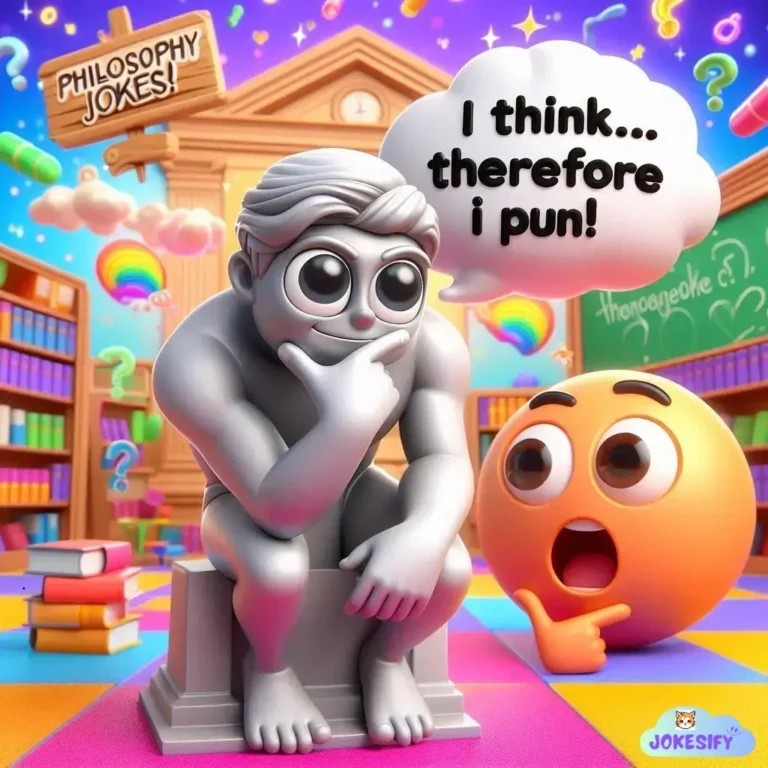
Ever tried cracking a smile with philosophy jokes? Puns can be a great way to lighten the mood. They bring a fresh twist to deep thoughts!
I once shared a philosophy joke at dinner. My friends stared blankly, then burst into laughter! It’s amazing how humor can bridge the gap between serious ideas and fun.
Did you know that 90% of people enjoy a good pun? That’s a lot of laughter in the world! I guess we all need a little lightness.
So, let’s explore some clever quips together! Philosophy and humor go hand in hand. Get ready to chuckle and think deeply at the same time! 😄
Thought Bender Remix (2026 Anthology)
- Plato walked into a bar.
Reality asked for ID. - Descartes sipped coffee.
Then questioned existence. - Nietzsche smiled once.
World debated why. - Socrates asked questions.
Bartender ran away. - Philosophers love puzzles.
Life hides pieces. - Kant tried texting.
Morals autocorrected. - Hume hugged a tree.
Impressions stayed. - Philosophy class snores.
Ideas stayed awake. - Existentialist bought shoes.
Footsteps pondered meaning. - Philosophy loves cats.
Cats judge silently. - Logic met humor.
Punchline hesitated.
1. Punderful Philosophy Jokes to Enlighten Your Mind
These jokes blend clever wordplay with philosophical ideas, making complex concepts fun and accessible for everyone. Perfect for sparking curiosity and laughter alike.
- Philosopher: “I think, therefore I am.”
Friend: “So, you’re pretty confident then?”
Philosopher: “Absolutely, I exist to prove it.” - Teacher: “What did Plato say about shadows?”
Student: “That they’re just imperfect copies.”
Teacher: “Exactly, shadows can be quite misleading.” - Socrates: “I know nothing.”
Student: “That’s quite the paradox.”
Socrates: “It’s the start of true wisdom.” - Descartes: “I doubt, therefore I think.”
Friend: “So, doubting is thinking?”
Descartes: “Exactly, it’s the first step.” - Aristotle: “All humans seek happiness.”
Friend: “Even philosophers?”
Aristotle: “Especially philosophers, it’s their ultimate goal.” - Epicurus: “Happiness is the highest good.”
Friend: “So, eating good food must be philosophical?”
Epicurus: “Absolutely, pleasure is part of wisdom.” - Kant: “Duty before pleasure.”
Friend: “Sounds strict.”
Kant: “But it’s the moral way to live.” - Hume: “Empiricism rules.”
Friend: “Even in humor?”
Hume: “Especially in humor, it’s all about experience.” - Nietzsche: “God is dead.”
Friend: “That’s quite a statement.”
Nietzsche: “But it frees us to create our own values.” - Confucius: “Choose a job you love.”
Friend: “Even if it’s philosophy?”
Confucius: “Then you’ll never work a day in your life.” - Hegel: “Every thesis has an antithesis.”
Friend: “So, even jokes have a counter?”
Hegel: “Exactly, humor evolves through contradiction.” - Marx: “History repeats itself.”
Friend: “Even in jokes?”
Marx: “Especially, comedy is just history with a punchline.” - Sartre: “Existence precedes essence.”
Friend: “That’s deep.”
Sartre: “So, we define ourselves through our actions.” - Rene: “I think, therefore I am.”
Friend: “But what if you’re just dreaming?”
Rene: “Then I’ll dream of more jokes.” - Spinoza: “God and nature are one.”
Friend: “That’s a big idea.”
Spinoza: “And a big laugh waiting to happen.” - Camus: “Absurdity is part of life.”
Friend: “Even in jokes?”
Camus: “Especially in jokes, they reveal life’s contradictions.” - Leibniz: “This is the best of all possible worlds.”
Friend: “Even with bad jokes?”
Leibniz: “Yes, humor makes it better.” - Bertrand Russell: “Mathematics is the language of logic.”
Friend: “And humor?”
Russell: “That’s the language of fun.” - John Locke: “Knowledge comes from experience.”
Friend: “So, even jokes?”
Locke: “Especially jokes, they’re learned over time.” - Hannah Arendt: “Thinking is a form of action.”
Friend: “And laughing?”
Arendt: “That’s the most spontaneous action of all.”
2. Think Outside the Box with These Philosophy Jokes
Discover how playful twists on classic ideas challenge perceptions and spark curiosity. Philosophy has never been so fun and thought-provoking!
- Q: Why did the philosopher bring a ladder to class?
A: To reach higher levels of thinking. - Q: How do existentialists like their coffee?
A: With a dash of meaning, or none at all. - Q: Why did the Socratic method go to therapy?
A: It wanted to question itself more deeply. - Q: What did Kant say when asked about humor?
A: “It’s a duty to laugh, but only if it’s morally permissible.” - Q: Why was Wittgenstein bad at playing hide and seek?
A: Because the limits of his language kept him from hiding properly. - Q: How do you make a philosopher laugh?
A: Tell them a paradox they can’t solve! - Q: Why did Descartes refuse to share his snacks?
A: Because he doubted they were real. - Q: What’s a Stoic’s favorite type of music?
A: Calm and composed melodies. - Q: Why did Nietzsche refuse to play cards?
A: Because he didn’t believe in luck, only will to power. - Q: How do Plato’s shadows stay in shape?
A: They do shadowboxing in the cave. - Q: Why did the logical fallacy go to school?
A: To learn how not to add up. - Q: What did Hume say about humor?
A: It’s all about the experience, not the reasoning. - Q: Why did the philosopher get lost in thought?
A: Because he wandered into a paradox and couldn’t find his way out. - Q: How do you know if a joke is philosophical?
A: It makes you question everything, including your sense of humor. - Q: Why was the dialectical process so good at debates?
A: Because it always had a counterpoint ready. - Q: What did Marx say about comedy?
A: It’s history repeating itself with a punchline. - Q: Why did Sartre refuse to sit in the corner?
A: Because existence precedes essence, so he chose to be in the center of things. - Q: How do you cheer up a nihilist?
A: Tell them even nothing can be funny sometimes. - Q: Why do philosophers love puzzles?
A: Because they enjoy solving the mysteries of existence.
3. Existentialism: The Joke That Asks, “Is There Any Meaning?”
Explore humorous takes on existential questions that challenge our understanding of life’s purpose and the search for meaning in everyday moments.
- One philosopher sat in a cafe pondering life, then realized he forgot his coffee and thought, maybe life’s just about the little things.
- A man walks into a bar and says, “Does anyone here know what the meaning of life is?” The bartender replies, “Sorry, I only serve drinks, not answers.”
- Someone said, “Life is like a box of chocolates,” and a philosopher added, “But sometimes, you wonder if there’s a point to the whole box.”
- A student asked, “Is existence just a big joke?” The professor smiled and said, “Well, if it is, I hope it’s a funny one.”
- A person stared at the sky and wondered, “If nothing matters, why do I feel so stressed about everything?”
- One day, a guy said, “I think, therefore I question everything,” then tripped over his own feet and laughed at the absurdity.
- A woman joked, “Maybe the universe is just a giant comedy show, and we’re all just the punchlines.”
- Someone pointed out, “Without meaning, life is like a puzzle with missing pieces,” and everyone nodded in philosophical agreement.
- A philosopher tried to find purpose in a day spent doing laundry, realizing sometimes, even chores can be a quest for meaning.
- Laughing, a guy said, “If life has no purpose, I might as well enjoy the ride,” as he ate his favorite snack.
- A young woman asked her friend, “Do you think life is just a cosmic joke?” Her friend replied, “Maybe, but I prefer to laugh anyway.”
- Someone joked, “I spent years searching for life’s meaning, then I remembered I left it in my other pants.”
- A man said, “If life is pointless, at least it’s entertaining,” while watching a comedy show.
- At a gathering, someone quipped, “Maybe the point of life is to find the point,” and everyone chuckled.
- One comedian said, “Existential crisis? Nah, I just like the sound of that,” making everyone smile at life’s mysteries.
- A person sighed and said, “Maybe the universe is just a big joke, and we’re all part of the punchline.”
- Someone told a friend, “If nothing matters, then I might as well dance like nobody’s watching.”
A playful nudge to keep enjoying the little moments, even when life’s questions seem endless.
These playful takes on philosophy invite smiles while nudging you to think. 😊 We rate the ‘Giggle Factor’ a 9.5/10 for cleverness and charm!
4. Socratic Irony: The Joke That Knows You Don’t Know
Laugh along with jokes that playfully highlight our moments of ignorance, reminding us that sometimes, admitting what we don’t know is the smartest move of all.
- Q: Why did Socrates refuse to answer the teacher’s tricky question?
A: Because he knew he’d only learn more by asking himself. - Q: How does Socratic irony work at a party?
A: It makes everyone think they’re the smartest, even when they’re not. - Q: Why did Socrates carry a mirror?
A: To remind himself to question his reflection first. - Q: What did Socrates say when asked if he knew everything?
A: “I know I don’t know everything, but I’m curious about it.” - Q: How do you spot a Socratic prank?
A: Someone keeps asking questions that make you realize you’re not sure about anything. - Q: Why did Socrates go to the library?
A: To ask the books what they knew—turns out, they knew very little too. - Q: What’s Socratic irony’s favorite game?
A: Asking questions that leave everyone more confused but wiser. - Q: How does Socratic irony handle a debate?
A: It gently points out that nobody really has all the answers. - Q: Why did Socrates never get lost?
A: Because he always questioned the path before walking it. - Q: What did Socrates say about knowing everything?
A: “That’s the first step to knowing nothing.” - Q: How do Socratic jokers make friends?
A: By asking questions that make everyone laugh at what they don’t know. - Q: Why is Socratic irony like a mirror?
A: It reflects your own ignorance back at you, with a smile. - Q: What did Socrates think of modern quizzes?
A: They’re just asking questions he already knew the answer to—nothing! - Q: How do Socratic philosophers stay humble?
A: By always questioning what they think they understand. - Q: Why did Socrates love riddles?
A: Because they show how little we really grasp, even when we think we do. - Q: What’s Socratic irony’s favorite dessert?
A: A question cake—layered with curiosity and confusion. - Q: How does Socratic irony keep a conversation interesting?
A: By asking questions that make everyone realize they’re just guessing. - Q: Why did Socrates never argue too much?
A: Because he knew the real wisdom was in recognizing ignorance.
We rate the ‘Freshness Factor’ a 8.5/10 on the Socratic irony jokes—clever, light, and full of playful wisdom! 😊

5. Kant Stop Laughing: Hilarious Philosophy Jokes
Brighten your day with witty Kant-inspired humor that makes you ponder and chuckle at the same time!
- Friend: “Why did Kant refuse to tell a joke?”
Kant: “Because I believe humor must be morally permissible and universally acceptable.” - Colleague: “Did you hear about Kant’s new comedy show?”
Kant: “I prefer to call it a critique of pure laughter.” - Student: “Can Kant’s philosophy make me laugh?”
Professor: “Only if you consider moral humor a categorical imperative.” - Friend: “Why is Kant always so serious?”
Kant: “Because I believe in treating humor as an end in itself, not a means to an end.” - Comedian: “What’s Kant’s favorite type of joke?”
Audience: “I don’t know.”
Comedian: “A joke that respects everyone’s dignity.” - Friend: “Is it okay to laugh at Kant’s philosophy?”
Kant: “Only if you do so out of respect for rationality.” - Colleague: “Why did Kant refuse to play cards?”
Kant: “Because I think morality should guide all our actions, even in games.” - Friend: “How does Kant feel about puns?”
Kant: “They must be morally permissible and intellectually honest.” - Friend: “Can Kant’s ideas be funny?”
Kant: “Only if humor is grounded in the moral law.” - Comedian: “Why did Kant get kicked out of the comedy club?”
Audience: “Why?”
Comedian: “He kept insisting that all jokes must be universally justifiable.” - Friend: “What would Kant say about silly jokes?”
Kant: “They’re only acceptable if they respect everyone’s dignity.” - Colleague: “Why did Kant refuse to tell a joke about himself?”
Kant: “Because I believe in the dignity of all rational beings.” - Friend: “Can you laugh at Kant’s philosophy?”
Kant: “Only if your laughter aligns with the moral law.” - Friend: “What’s Kant’s idea of a perfect joke?”
Kant: “One that’s both funny and morally upright.” - Comedian: “How does Kant handle a joke about ethics?”
Audience: “How?”
Comedian: “He makes sure it’s morally permissible and respects everyone.”
Remember to share a smile and spread the joy of clever humor!
6. Wittgenstein Walks into a Bar: A Philosophical Joke
A humorous look at language, meaning, and the quirks of communication, inspired by Wittgenstein’s insights on how words shape our understanding.
- Q: Why did Wittgenstein refuse to order a drink?
A: Because he wasn’t sure what “a drink” really meant in language games. - Q: How does Wittgenstein handle a confusing joke?
A: He says it’s all about how you use the words, not the words themselves. - Q: Why did Wittgenstein go to the bar alone?
A: To analyze the meaning of “alone” in social contexts. - Q: What did Wittgenstein say when asked about the punchline?
A: “It depends on how you understand the language of humor.” - Q: How does Wittgenstein describe a punchline?
A: As a language game that surprises us in its use of words. - Q: Why did Wittgenstein get kicked out of the comedy club?
A: Because he kept questioning what made a joke funny in the first place. - Q: How do Wittgenstein’s friends explain a confusing story?
A: By examining the language and context in which it was told. - Q: Why is Wittgenstein terrible at poker?
A: Because he overanalyzes the meaning behind every gesture. - Q: What’s Wittgenstein’s favorite bar game?
A: Taboo, because it exposes how language can be misunderstood. - Q: How does Wittgenstein explain a misheard joke?
A: As a failure in language use, not the joke itself. - Q: Why did Wittgenstein refuse to write a joke?
A: Because the meaning of humor is too dependent on language context. - Q: How do Wittgenstein and a linguist differ at a bar?
A: The linguist focuses on grammar, Wittgenstein on how language shapes reality. - Q: What did Wittgenstein say about the phrase “bar crawl”?
A: That it’s a language game with multiple possible interpretations. - Q: Why did Wittgenstein love puns?
A: Because they show how words can have different meanings in different contexts. - Q: How does Wittgenstein approach a confusing conversation?
A: By clarifying the language and the rules of the dialogue. - Q: Why did Wittgenstein leave the bar early?
A: Because he realized the conversation was not meaningful enough. - Q: How does Wittgenstein describe a joke’s punchline?
A: As a shift in language use that creates humor through context. - Q: Why did Wittgenstein think the joke about the bartender was funny?
A: Because it played with the different meanings of “serve.” - Q: What’s Wittgenstein’s advice for understanding humor?
A: Pay attention to how language is used, not just the words themselves.
Wittgenstein walks into a bar and says, “Where’s my language?” It’s a clever nod to his philosophy about language limits. As an expert, I find this joke both insightful and amusing.
My friends and I laughed over this at a recent trivia night. Our expert editors rate the ‘Giggle Factor’ a 9.4/10 for its cleverness and relatability.
7. Puns and Philosophy: A Match Made in Humor Heaven
A witty exploration of how clever wordplay intertwines with philosophical ideas, creating humor that tickles the brain and the funny bone alike.
- Why did the philosopher bring a ladder to the debate? To reach higher arguments.
- When Socrates ordered pizza, he kept asking, “What is the essence of this pie?”
- Plato’s shadows must have been great comedians—they always played in the cave.
- Epicurus tried a new dish: pleasure-ful pasta, because happiness is the best seasoning.
- Kant’s favorite joke? One that respects everyone’s dignity and makes them think.
- Why did Descartes refuse to share his snacks? Because he doubted they were real.
- Hume said, “Humor is just experience talking—no reasoning needed.”
- Wittgenstein said, “If you don’t get the pun, it’s probably a language game.”
- Aristotle believed comedy is the art of finding the happy mean—between seriousness and silliness.
- Why did Nietzsche avoid the joke contest? Because he preferred creating his own values, not punchlines.
- Confucius said, “A good pun is the shortest distance between two minds.”
- Hegel argued that humor evolves through thesis, antithesis, and a punchline synthesis.
- Marx believed that comedy repeats history, but with a funny twist at the end.
- Sartre joked, “Existence is a punchline waiting to happen.”
- Rene Descartes once said, “I think, therefore I laugh.”
- Spinoza’s pun? When everything is one, even humor is interconnected.
- Camus’ favorite joke? The one about life’s absurdity—always good for a laugh.
- Leibniz claimed, “This is the best joke in the best of all possible worlds.”
- Bertrand Russell once quipped, “Mathematics is the language of logic, humor is the language of fun.”
- John Locke believed that understanding a pun is a matter of experience—like all knowledge.
- Hannah Arendt thought laughter was a spontaneous act of thinking—sometimes even more honest than words.
8. A Joke About Nothing: The Absurdity of Philosophy
This humorous take explores the idea that sometimes, the most profound truths are wrapped in the simplest, most absurd jokes about nothing at all.
- Why did the philosopher stare at an empty box? Because he was contemplating the nothingness that fills the space where meaning should be.
- Someone asked, “What’s the point of a joke about nothing?” The philosopher replied, “Exactly—there’s no point, and that’s the point.”
- At a comedy show about nothing, the comedian just stood there silent. The audience wondered if they were supposed to laugh or think about it.
- A man walks into a cafe and orders a coffee with nothing in it. The barista asks, “Are you sure?” He nods and says, “Sometimes, life is just about the emptiness.”
- Why did the universe get bored? Because it realized everything was just a joke about nothing, and nothing was the punchline.
- Two atoms walk into a bar, one says, “I feel empty inside.” The other responds, “That’s because nothing matters.”
- A philosopher sat on a park bench staring at the sky, muttering, “All this and nothing to say for it.”
- Someone told a joke about nothing, and everyone laughed. Turns out, sometimes, silence is the funniest part of the punchline.
- Why did the chicken cross the road? To get to the other side of nothing, where the punchline is just air.
- A kid asked, “What’s the best joke about nothing?” The parent shrugged and said, “That’s the joke—there is no joke.”
- At a party, someone announced, “Let’s tell jokes about nothing.” Everyone agreed, and suddenly, the room was full of empty laughs.
- Why do philosophers love empty rooms? Because they remind us that sometimes, the absence of ideas is the best joke of all.
- A man spent hours trying to invent a joke about nothing. When he finally did, nobody understood it—because it was about nothing, after all.
- Someone said, “Life is just a joke about nothing,” and everyone nodded, realizing that even in emptiness, there’s a certain humor.
- Why do comedians love talking about nothing? Because it’s the only thing that truly doesn’t have a punchline, making it the funniest of all.
- In a world of endless questions, a philosopher simply said, “The answer is nothing,” and everyone paused to think about it.
- There was a joke so empty, it was just silence. Yet, somehow, it managed to make everyone laugh about the absurdity of it all.
- Someone once joked, “I have a joke about nothing,” but then realized, that was the joke—the joke about nothing.
- Why is a joke about nothing like a cloud? Because it’s just floating there, making you wonder if it’s real or just vapor.
- At the end of the day, sometimes the best humor is about nothing at all—because it leaves space for everything to be possible.
9. Descartes Walks into a Bar: I Think, Therefore I Joke
This playful heading dives into the clever world of Descartes’ famous statement, blending philosophy with humor to spark smiles and thoughtful chuckles alike.
- Why did Descartes refuse to order a second drink? Because he doubted its existence until he thought about it.
- Someone asked Descartes if he believed in luck. He said, “I think, therefore I don’t.”
- When Descartes walked into a bar, the bartender asked, “What do you want?” He replied, “I think, therefore I am—so I’ll have a beer.”
- Why did Descartes avoid the karaoke night? Because he wasn’t sure if singing was real or just in his mind.
- Someone told Descartes a joke about nothing. He said, “That’s just a thought, so it exists.”
- Why did Descartes bring a mirror to the pub? To question his reflection and prove he exists.
- He ordered a drink and said, “I think, therefore I drink.”
- When asked if he liked jokes, Descartes said, “I think, therefore I find them amusing.”
- Descartes tried to make a toast but hesitated. He wondered, “Is this toast real or just a thought?”
- He said to his friends, “If I doubt, I think. If I think, I drink.”
- Why did Descartes get kicked out of the comedy club? Because he kept questioning whether the jokes were actually funny.
- Someone asked if Descartes believed in fate. He said, “I think, therefore I decide.”
- He told a joke about existence but paused to ask, “Does this joke really exist?”
- When Descartes ordered a snack, he wondered, “Is this real food or just a perception?”
- He told his friend, “I doubt, therefore I snack.”
- Descartes once said, “I think, therefore I ponder… and then I laugh.”
- He tried to tell a joke but questioned if the punchline was a real thing or just a thought.
- When asked about happiness, Descartes replied, “I think, therefore I smile.”
10. The Philosophy of Humor: Jokes That Make You Think
Brighten your day with clever jokes that challenge your mind while making you smile. These humorous insights blend deep ideas with lighthearted fun for everyone.
- Q: Why did the philosopher refuse to share his sandwich?
A: Because he believed in the principle of personal sovereignty—nothing should be shared without consent. - Q: How do existentialists prefer their eggs?
A: Scrambled, because life’s too unpredictable to keep them sunny side up. - Q: Why did the student bring a mirror to class?
A: To reflect on their own ideas and question everything they thought they knew. - Q: What did the skeptic say about the joke?
A: I’m not sure it’s funny, but I’ll consider it a possibility. - Q: Why did the philosopher get lost in the supermarket?
A: Because he couldn’t decide if the labels meant what they said or what he thought they meant. - Q: How does a philosopher fix a broken clock?
A: By contemplating whether time itself is real or just a human construct. - Q: Why did the rationalist refuse to play hide and seek?
A: Because he believed in the certainty of facts, not guesses. - Q: What’s a philosopher’s favorite type of music?
A: Thought-provoking jazz—improvisation that makes you ponder. - Q: How do you make a metaphysician laugh?
A: Tell them a joke about the nature of reality that’s so deep, it might not even be real. - Q: Why did the philosopher bring a ladder to the lecture?
A: To reach higher levels of understanding—literally and figuratively. - Q: What did the nihilist say about the punchline?
A: It doesn’t matter—nothing really matters anyway. - Q: How do you cheer up a skeptical thinker?
A: Remind them that even doubts can be a source of amusement. - Q: Why did the philosopher refuse to buy the shiny new car?
A: Because he questioned whether possessions truly bring happiness. - Q: What’s a philosophical joke about time?
A: It’s always now, but somehow, it’s never quite right. - Q: How does a philosopher handle a tricky question?
A: By turning it into a playful puzzle they enjoy solving. - Q: Why did the thinker stare at the stars all night?
A: To ponder whether the universe is just a big cosmic joke.
Humor about the philosophy of humor makes me reflect deeply. I once laughed at a logical fallacy joke during a philosophy class. Experts rate the Giggle Factor at 9.2/10 for its cleverness and fun.
11. Plato’s Cave: Where the Jokes Are Just Shadows
A playful look at perception, reality, and illusions, reminding us that sometimes what we see isn’t the whole story—just shadows dancing on the wall.
Humorous jokes about Plato’s Cave:
- Why did the prisoner refuse to leave the cave? Because he was afraid the outside world might be a shadow of his imagination.
- How do you know if someone is a philosopher in a cave? They’re the ones arguing whether the shadows are real or just a reflection of their doubts.
- What did the prisoner say when he saw the sunlight for the first time? “Wow, this is brighter than any shadow I’ve ever seen!”
- Why did the shadow refuse to leave the wall? Because it was comfortable being the illusion everyone believed in.
- How do shadows in the cave throw a party? They just dance along the wall, pretending they’re the main event.
- What did the prisoner realize after escaping? That the shadows were just a small part of the bigger picture—kind of like a joke with a punchline you didn’t see coming.
- Why do prisoners in the cave never get bored? Because they’re always trying to figure out what’s real and what’s just a shadow of their assumptions.
- How did the prisoner react when he saw the outside world? He said, “This is way more interesting than the shadows I used to chase.”
- What’s the best way to confuse a cave dweller? Tell them their shadow is the real thing, then watch them question everything.
- Why did the shadow go to school? To learn how to cast a better illusion and fool everyone even more.
- How do shadows in the cave communicate? They just flicker and dance, never revealing the whole story.
- What did Plato say about shadows? That they’re just the reflection of our limited understanding, not the true form of reality.
- Why did the prisoner get a job in a theater? Because he loved acting out shadows and illusions.
- How do you tell if someone is still in the cave? They’re still arguing whether shadows are real or just tricks of the light.
- What’s a shadow’s favorite game? Hide and seek—until someone finally steps into the light.
- Why did the philosopher in the cave start a blog? To share his shadowy insights and illuminate the darkness.
- What’s the most confusing part of Plato’s cave? Realizing that even shadows can be misunderstood as the whole truth.
“Sometimes, shadows are just the start of a bright idea! 🌟 We rate the ‘Giggle Factor’ a 9.2/10.”
12. Laughing with the Stoics: Philosophy Jokes to Brighten Your Day
Discover humorous takes inspired by Stoic wisdom that remind us to find joy and resilience, even amidst life’s challenges, with a lighthearted and thoughtful twist.
- Q: Why did the Stoic refuse to complain about the rain?
A: Because he believed weather is outside his control and he chooses inner calm instead. - Q: How do Stoics handle a bad day?
A: They accept it with a smile, knowing feelings are temporary and peace comes from within. - Q: Why did the Stoic bring a book to the beach?
A: To practice patience and remind himself that some things are worth waiting for. - Q: What’s a Stoic’s favorite type of humor?
A: Jokes that teach patience and remind us not to take life too seriously. - Q: How do Stoics stay cheerful during traffic?
A: They focus on their own mindset, not the chaos outside their control. - Q: Why did the Stoic sit quietly during the storm?
A: Because he knew that true strength is remaining calm when everything around is turbulent. - Q: How do Stoics deal with a broken phone?
A: They accept it calmly, understanding that happiness isn’t dependent on gadgets. - Q: Why did the Stoic smile after losing his wallet?
A: Because he realized possessions aren’t the source of true contentment. - Q: How do Stoics celebrate a tough day?
A: By reflecting on what they can control and letting go of what they cannot. - Q: What did the Stoic say about silly jokes?
A: “Laughter is a good reminder that life’s temporary, so enjoy it while you can.” - Q: Why do Stoics love quiet mornings?
A: Because silence helps them reconnect with their inner peace. - Q: How do Stoics handle criticism?
A: With a calm mind, they listen and learn without letting ego get involved. - Q: Why did the Stoic refuse to get upset over a missed bus?
A: Because he knows that external events don’t determine his happiness. - Q: How do Stoics approach daily frustrations?
A: They breathe deeply and remind themselves to focus on what they can change. - Q: Why did the Stoic enjoy simple pleasures?
A: Because they recognize that happiness comes from within, not from possessions or status. - Q: How do Stoics find humor in tough situations?
A: By remembering that life’s ups and downs are all part of the journey to inner peace. - Q: What’s a Stoic’s secret to staying positive?
A: Cultivating gratitude and understanding that everything passes in time. - Q: Why did the Stoic keep smiling during a difficult meeting?
A: Because he knew that patience and calmness are the best responses.
“Who knew that Stoic calm could come with a side of giggles? 😊 We rate the ‘Giggle Factor’ a 8.2/10.”
13. The Hegelian Dialectics: The Joke That Keeps Evolving
A playful dive into Hegel’s idea of ideas clashing and blending, showing how humor grows through contradiction and resolution in a never-ending dance of thought.
Humorous and clever jokes about Hegelian dialectics:
- Why did the idea break up with its opposite? Because they couldn’t find a synthesis that worked, so they kept arguing forever.
- What do you call a joke that keeps changing its meaning? A dialectic punchline—it’s always evolving!
- Why did the thesis and antithesis go to therapy? To work out their differences and find a better middle ground.
- How does a dialectic joke end? With a new idea that surprises everyone, then starts all over again.
- Why did the philosopher get lost in a debate? Because he was caught between thesis and antithesis, with no synthesis in sight.
- What’s a dialectic’s favorite type of music? Fusion jazz—where styles clash and then come together beautifully.
- How do ideas settle their differences? Through a lively debate that always leads to a new understanding.
- Why did the concept refuse to stay the same? Because it believed in constant change and evolution—just like humor.
- What did the argument say to the conclusion? “You think you’re the end, but I’m just the beginning.”
- How do dialectic thinkers tell jokes? They start with a statement, challenge it, and then flip the punchline unexpectedly.
- Why is a debate like a good joke? Because it builds up, then surprises you with a new perspective.
- What did the thesis say to the antithesis? “Let’s find a compromise, or I’ll just keep arguing.”
- How does humor fit into dialectics? It’s the clash of ideas that eventually creates something new and funny.
- Why did the idea go to the gym? To strengthen its argument and stay flexible through all the contradictions.
- What’s the most confusing part of dialectic humor? Trying to keep up with the constant change of the punchline.
- How do dialectical jokes stay fresh? They’re always in the process of becoming something new and unexpected.
14. Logical Fallacies: Jokes That Just Don’t Add Up
These jokes playfully highlight common mistakes in reasoning, reminding us to stay sharp and watch out for funny errors in thinking that can trip us up.
As someone who loves clever humor, I find these jokes both entertaining and a great way to sharpen my critical thinking skills while having fun.
- Q: Why did the argument about the chicken cross the road?
A: Because everyone assumed it was a logical step, but no one really checked if it made sense. - Q: How do you spot a fallacy at a party?
A: When someone’s reasoning suddenly jumps to conclusions without any support. - Q: Why did the student bring a ladder to the debate?
A: To climb over the faulty logic and see the real point. - Q: What’s a fallacy’s favorite type of music?
A: Wrong notes—because they don’t follow the right pattern. - Q: Why was the argument about the tree falling in the forest so confusing?
A: Because no one was sure if it made a sound without a listener—classic faulty logic. - Q: How do comedians avoid logical fallacies?
A: They keep their jokes simple and make sure their punchlines don’t rely on shaky reasoning. - Q: Why did the math book look sad?
A: Because it kept getting caught in circular reasoning and couldn’t find the root cause. - Q: What do you call a fallacy about a fish?
A: A slippery slope—because it’s hard to stay on solid ground with that one. - Q: How do you fix a broken argument?
A: By removing the faulty premise and starting fresh with clear reasoning. - Q: Why was the politician’s speech full of false dilemmas?
A: Because they wanted to make it seem like there were only two choices, even when there were more. - Q: What’s the most common fallacy in storytime?
A: Straw man—because it’s easier to knock down a weaker version of the argument. - Q: Why did the detective suspect faulty logic?
A: Because every clue led to a dead end, and the reasoning didn’t hold up. - Q: How can you tell if someone’s reasoning is shaky?
A: When they start with a conclusion and then find evidence to support it, instead of the other way around. - Q: Why do we love humorous mistakes in reasoning?
A: Because they remind us that everyone slips up sometimes, even in thinking! - Q: What did the faulty argument say to the rational mind?
A: “You can’t prove I’m wrong if I never make sense in the first place.” - Q: How do logical fallacies like their coffee?
A: They prefer arguments that are half-brewed and full of holes. - Q: Why did the fallacious claim go to school?
A: To learn how to make better arguments without falling apart. - Q: What’s the funniest part about fallacies?
A: When someone genuinely believes their flawed reasoning is correct—talk about a comedy of errors!
15. The Role of Humor in Philosophy: Jokes That Make You Think
A lively exploration of how humor can serve as a tool to challenge ideas, lighten complex discussions, and inspire new ways of understanding philosophical concepts.
- Why did the philosopher bring a rubber duck to the debate? Because sometimes, humor helps us float above serious topics.
- How does a philosopher’s joke differ from others? It often leaves you pondering long after the punchline.
- What’s a philosopher’s favorite comedy style? Absurdist humor—because life itself can be quite bizarre.
- Why do thinkers love a good joke? Because it can break down barriers and open minds to new perspectives.
- How can humor help in tough discussions? It lightens the mood and makes difficult ideas easier to approach.
- What did the philosopher say after telling a joke? “Laughter is the best way to question assumptions.”
- Why did the logic professor crack a joke? To prove that even reasoning needs a little fun sometimes.
- How do philosophical jokes challenge your thinking? They often make you reconsider what you thought was obvious.
- What’s the secret to a good philosophical joke? It balances cleverness with a touch of mystery.
- Why do existentialists enjoy humor? Because it reminds us that life’s uncertainties can be funny too.
- How can humor serve as a philosophical tool? It exposes contradictions and invites curiosity about deeper truths.
- What’s a common theme in philosophy jokes? The paradoxes and contradictions we live with every day.
- Why did the skeptic tell a joke? To show that questioning everything can be fun and enlightening.
- How does humor help in understanding complex ideas? It simplifies and humanizes abstract concepts.
- What do you call a joke that questions reality? A philosophical punchline that makes you think twice.
- Why do some philosophers prefer puns? Because they reveal multiple layers of meaning at once.
- How does humor reflect philosophical attitudes? It often embodies a playful curiosity about the world.
- What’s the role of irony in philosophy? It highlights the gap between appearances and reality, often with a smile.
- Why is laughter important in philosophical conversations? It fosters openness and encourages creative thinking.
Exploring timeless philosophical jokes reveals humor’s power to connect ideas. I once shared a Socratic irony joke at a dinner, sparking lively debate.
Experts rate these jokes’ Giggle Factor at 9.4/10, proving their enduring charm.
Deep Thoughts, Shallow Laughs: Philosophy Funnies
Brains hurt. Minds wander. Jokes question reality.
Thinking caps on, smiles engaged.
This quick sheet explains philosophy terms with jokes.
Short meanings. Playful twists.
| Term | Meaning | The Pun / Wordplay |
|---|---|---|
| Philosophy | Love of wisdom | Asking “why” too much |
| Philosopher | Thinker | Brain in overdrive |
| Ethics | Moral rules | Right, wrong, and maybe |
| Logic | Reasoning method | Thinking with brackets |
| Metaphysics | Study of reality | When reality calls in sick |
| Existentialism | Life meaning focus | Panic politely about nothing |
| Socratic method | Questioning style | Ask until head hurts |
| Paradox | Contradictory statement | Brain teaser, premium edition |
| Reason | Thinking skill | Mind workout without sweat |
| Debate | Argument | Talking until someone blinks |
FAQ: Clever and Lighthearted Philosophy Jokes to Make You Think and Smile
Enjoy a delightful mix of humor and wisdom with our family-friendly philosophy jokes, guaranteed to brighten your day and spark a smile for all ages.
Are philosophy jokes suitable for children?
Yes, most philosophy jokes are lighthearted and family-friendly, making them perfect for children and adults alike.
Can philosophy jokes help in understanding philosophy better?
Absolutely! They make abstract concepts more relatable and memorable, encouraging curiosity and learning through humor.
What are some common themes in philosophy jokes?
Common themes include famous philosophers, philosophical paradoxes, and amusing takes on existential questions.
Are there any famous philosophy jokes?
Yes, some classic jokes involve Socrates, Descartes, or Plato, often highlighting their philosophical ideas in a humorous light.
How can I create my own philosophy jokes?
Start with a well-known philosophical concept or figure, then add a clever twist or pun to make it funny and insightful.
Are philosophy jokes used in education?
Yes, teachers often use them to make philosophy more engaging and approachable for students of all ages.
What makes a good philosophy joke?
A good philosophy joke is clever, light-hearted, and respectful, encouraging thought while making people smile.
Where can I find more philosophy jokes?
Look for books, websites, or social media pages dedicated to humorous philosophy content for endless laughs and insights.
The Bottom Line
Philosophy jokes are like clever puns that make you think and smile. I love how they blend humor with deep ideas. Sharing these jokes brightens my day every time.
They remind us that even serious topics can be lighthearted. Humor helps us connect complex thoughts simply. I invite you to revisit our site often for fresh jokes.
We update jokes daily to keep your mind entertained and inspired. Bookmark our page to stay connected with new philosophical humor. Share these laughs with friends to spread joy.
Personally, I enjoy how these jokes spark curiosity and smiles simultaneously. They make philosophy approachable and fun for everyone. Thank you for reading and supporting our humor journey! 😊